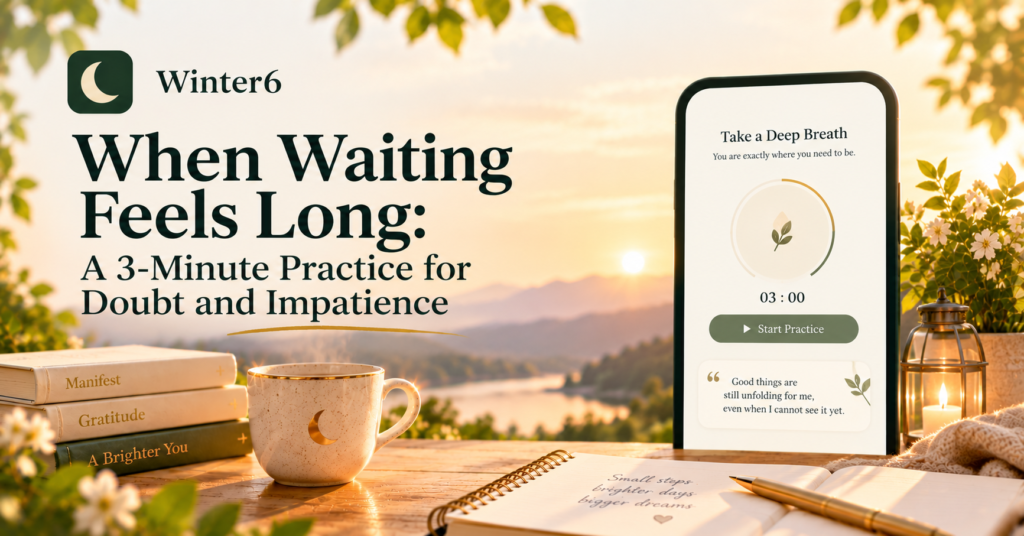
When waiting for something you are manifesting starts to feel long, the most useful thing you can do is come back to today. This 3-minute practice does that in four steps: name what you are feeling, bring your attention back to the room you are in, reconnect with your intention from a calm place, and choose one small next step. It does not ask you to force positive feelings. It helps you meet the doubt, settle it, and return to your practice with steadier energy.
The 3-minute practice
1. Name the feeling (30 seconds). Say or write it plainly: "I feel impatient." "I feel doubtful." "I feel tired of waiting." Naming it is enough. You do not need to explain it.
2. Come back to now (45 seconds). Put your feet on the floor. Notice five things you can see, three things you can hear and the feeling of your breath. Let your shoulders drop on the out-breath.
3. Reconnect with your intention (60 seconds). Read your intention or affirmation slowly, once. Then answer one question: What would the person who already has this feel right now? Let yourself borrow that feeling for a few breaths.
4. Choose one next step (45 seconds). One small, real action for today. Send the message. Update the profile. Rest without guilt. Write it down.
That is the whole practice. Use it whenever the waiting feels heavy.
Words to use when doubt arrives
- "I notice I'm feeling doubtful, and I can still take my next step."
- "My intention is set. Today I'm living as the person who has it."
- "I don't need to know how. I only need to know what's next."
- "Things are moving in ways I can't always see yet."
Choose the one that feels most true and keep it somewhere you'll see it.
Prompts for impatient days
- What has already shifted since I set this intention, even slightly?
- What would I be doing today if I knew it was already on its way?
- Which part of the life I want can I live a little of today?
- What is one thing I can stop checking or controlling this week?
- What am I enjoying now that I don't want to rush past?
An example
This is an illustration, not a real person's experience.
It's been three months since a designer started applying for new roles. On Tuesday evening another week passes without a reply, and the old frustration rises. She sits down and writes: "I feel impatient and a bit flat." She looks around her room, notices the lamp, the plant, the sound of rain, and lets her breath slow. She reads her affirmation, "I am the kind of designer studios want on their team," and asks what that designer would feel tonight. The answer is: settled, focused on her craft. Her next step is to spend twenty minutes improving one case study, then close the laptop. She writes it down and does it.
What research says
Established evidence: putting feelings into words. In a brain-imaging study, people who labelled the emotion in a photo of a face ("angry", "afraid") showed less activity in the amygdala, a region involved in emotional alarm, than when they simply matched a name to the face. The researchers suggested that putting feelings into words helps regulate them. (Lieberman et al., 2007, via ScienceDaily) Step 1 of this practice uses the same idea.
Established evidence: specific next steps. Plans that link a specific time or situation to a specific action, known as implementation intentions, had a medium-to-large effect on reaching goals across 94 tests. (Gollwitzer & Sheeran, 2006) Step 4 turns a waiting period into a moment of action.
Manifestation framework. In manifestation practice, the way you feel while waiting is part of the practice. Returning to the feeling of already having, and acting from it, keeps your identity aligned with what you want. This is a framework for practice rather than a scientific finding.
Frequently asked questions
How long does it take for a manifestation to show up?
There is no fixed timeline, and different intentions move at different paces. Keep your attention on your daily practice and the steps you can take, and write down every shift you notice along the way.
Is it bad to feel doubt?
No. Doubt is a normal part of wanting something. The practice is to notice it, settle it and return, not to never feel it.
Should I keep checking for signs?
Notice them, write them down, then let them go. Constant checking keeps your attention on the gap; a weekly read-back of your notes shows progress more clearly.
What if I want to give up?
Make the practice smaller rather than stopping: one minute with your intention, one small step. Small and steady carries you further than big and occasional.
A practice for how you feel today
Winter6 includes four guided practices of about three minutes for exactly these moments: when you feel calm and ready, doubtful, tense, or tired of waiting for a result. Each ends with one sentence to carry into your day.