A manifestation journal prompt is a question that asks you to write from the life you are choosing, as if it is already yours. The ones below are grouped by what you want: self-worth, money, love, work, energy, and the small signs you notice day to day. Pick the group that matches your intention, choose one prompt, and write for about ten minutes in the present tense. Answer one prompt a day rather than all sixty at once. The point is not the perfect answer. It is the hour later, when a thought from the page comes back to you on its own.
How to use these prompts in 10 minutes
- Choose one intention. Keep it to a single sentence, such as "I work somewhere that values me" or "I have three months of savings". Writing toward one thing gives the page a direction.
- Pick one prompt from the matching group. If none fits today, take one from "Everyday signs and gratitude". Those work for any intention.
- Write in the present tense, as the person who already lives it. Not "I will feel calm" but "I feel calm when I open my banking app." Concrete details matter more than big words: what the room looks like, what you say, what you decide.
- Finish with one line about today. One small action, one thing you will notice, or one sentence you will carry with you. This turns the page into something you do, not only something you imagine.
Ten minutes is enough. On busy days, three honest sentences still count.
Self-worth and identity
- What does a normal Tuesday look like for the version of me who already trusts my own judgement?
- Which decision did I make easily today that I would once have overthought?
- How do I speak to myself when I make a small mistake now?
- What do I no longer explain or apologise for?
- Which compliment do I simply accept these days, and how does it feel to say thank you?
- What do I wear, eat and listen to when I am treating myself as someone worth caring for?
- Where in my life am I already the person I want to be, even partly?
- What boundary do I hold calmly, and what does that make room for?
- If I believed I deserved good things by default, what would I ask for this week?
- Describe the moment today when I felt most like myself.
Money and abundance
- What does my bank balance look like on an ordinary morning, and what do I feel when I see it?
- How do I make money decisions now? Describe one I made with ease.
- What do I spend on without guilt, because it genuinely improves my life?
- Where did money or value come to me this week, in any form: a discount, a gift, an offer, a favour?
- What do I do with my first hour of free time now that money feels steady?
- Who do I enjoy being generous with, and what do I give?
- What does "enough" look like for me, in numbers and in feelings?
- Which skill or idea of mine is worth more than I used to charge for it?
- Describe my relationship with money as if it were a friendship I am glad to have.
- What is one money action I take today that the abundant version of me would take?
Love and relationships
- How does my partner (or the people closest to me) greet me when I come home?
- What do I feel safe saying out loud in my relationships now?
- Describe a quiet evening with someone who chooses me, in detail.
- What do I give in love that feels natural rather than effortful?
- Which friendships are growing, and what makes them easy?
- How do I respond now when someone is not available, without taking it personally?
- What does being cherished look like in small, daily ways?
- What did someone do for me recently that I let myself fully receive?
- Who am I in a relationship where I am completely at ease?
- Write a thank-you note to a person who has not arrived in my life yet.
Work and purpose
- What do I do in the first hour of a working day I love?
- Which problems do people bring to me because I am good at solving them?
- Describe the message I receive with the offer I have been waiting for.
- How do I feel walking into work, or opening my laptop, on a good Monday?
- What do I say yes to now, and what do I decline without stress?
- Which part of my work would I do even unpaid, and how is it now part of my paid work?
- Who do I work with, and how do they describe me when I am not in the room?
- What did I finish this week that I am quietly proud of?
- What does my workspace look like, sound like and smell like?
- What is one step I take today that the person in my ideal role would take without hesitating?
Energy, body and calm
- How do I wake up on a day when I have plenty of energy?
- What does my body enjoy doing, and when did I last give it that?
- Picture the calm version of me in a busy moment. What do I notice first?
- Which evening routine helps me fall asleep feeling settled?
- What do I do now when stress arrives, that I did not know how to do before?
- Where in my body do I feel ease today?
- What does it look like to take care of myself without needing a reason?
- Which place, person or song brings my energy back?
- What does rest feel like when I no longer feel I have to earn it?
- What is one kind thing I do for my body today?
Everyday signs and gratitude
- What three things went right today, and what part did I play in them?
- Which small coincidence or "sign" did I notice this week?
- What did life send back today that matches what I have been writing about?
- What did I see differently today than I would have a month ago?
- Who helped me today, even in a tiny way?
- What am I looking forward to, and what about it makes me smile?
- What is already here that I once hoped for?
- What made me laugh today?
- Which ordinary moment would I like to remember from this week?
- What shifted in me today, even by one degree?
An example: one prompt, ten minutes
Here is how a page might look. This is an illustration, not a real person's entry.
Say your intention is "I work somewhere that values me," and you pick Work and purpose, prompt 1: What do I do in the first hour of a working day I love?
I get in at nine and the first thing I do is make tea, because nobody expects me to answer messages in the first fifteen minutes. My manager asks for my view in the morning meeting and actually writes it down. I spend the rest of the hour on the project I proposed myself. I feel focused, not rushed. When someone thanks me, I just say "you're welcome".
Today: I will finish the proposal draft I keep postponing, and send it before lunch.
Notice what the entry does. It is specific (tea, the meeting, the proposal). It describes how the person feels and decides, not only what they own. And the last line turns the picture into one real step.
What the research says
Manifestation journaling draws on a few practices that psychologists have studied directly. It helps to keep them separate from the ideas that belong to manifestation itself.
Established evidence: writing about your best possible future. In a 2001 study, psychologist Laura King asked students to spend 20 minutes a day, for four days, writing about their "best possible self", the life they would have if everything went as well as it could. Compared with a control group, they reported higher well-being three weeks later. (King, 2001, Personality and Social Psychology Bulletin) A 2019 meta-analysis of 29 studies with 2,909 participants found that this exercise reliably raised well-being, optimism and positive mood, with small-to-moderate effects. (Carrillo et al., 2019, PLOS ONE)
Established evidence: counting what is going well. In Emmons and McCullough's 2003 studies, people who regularly wrote down things they were grateful for scored higher on several (though not all) measures of well-being than comparison groups. (Emmons & McCullough, 2003, Journal of Personality and Social Psychology) The "Everyday signs and gratitude" prompts use the same move.
Plausible interpretation: why present-tense detail helps. Writing a specific scene gives your attention something concrete to look for during the day. That is a reasonable explanation for why people often notice more opportunities after journaling. Studies have not tested it directly for manifestation journals.
Manifestation framework. Within manifestation practice, writing as the person who already has what you want is a way of rehearsing that identity until it feels normal. When it feels normal, your choices follow it. This is the core idea behind these prompts. It is a practice framework rather than a finding from the studies above, which measured mood, optimism and well-being.
Frequently asked questions
How often should I write in a manifestation journal?
Daily works best, because the habit is what keeps your attention on your intention. Ten minutes a day is enough; consistency matters more than length.
Should I write in the present or the future tense?
Present tense, as if it is already true: "I live in a bright apartment near the park." It keeps you writing from the identity you are building rather than from the waiting.
Can I use more than one prompt a day?
Yes, but one is usually better. Going deeper into one scene gives you more detail to carry into the day than skimming three.
What should I do when a prompt feels hard to answer?
Write the smallest true version of it: one part of the scene you can already believe. Or switch to a gratitude prompt for the day and come back later.
Do I need a special notebook?
No. Any notebook works. If you prefer your phone, keep your entries in one place so you can read back over them.
Keep your prompts in one place
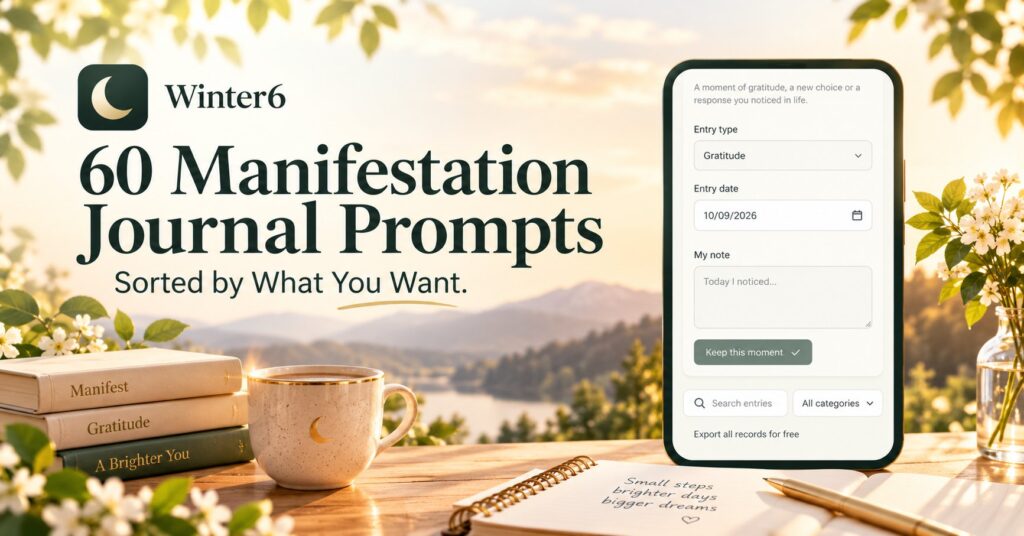
The Winter6 journal has four entry types (gratitude, shifts, life's responses and practice notes) that match the last group of prompts. Write today's entry there, and read your entries back whenever you want to see how far you have come.